
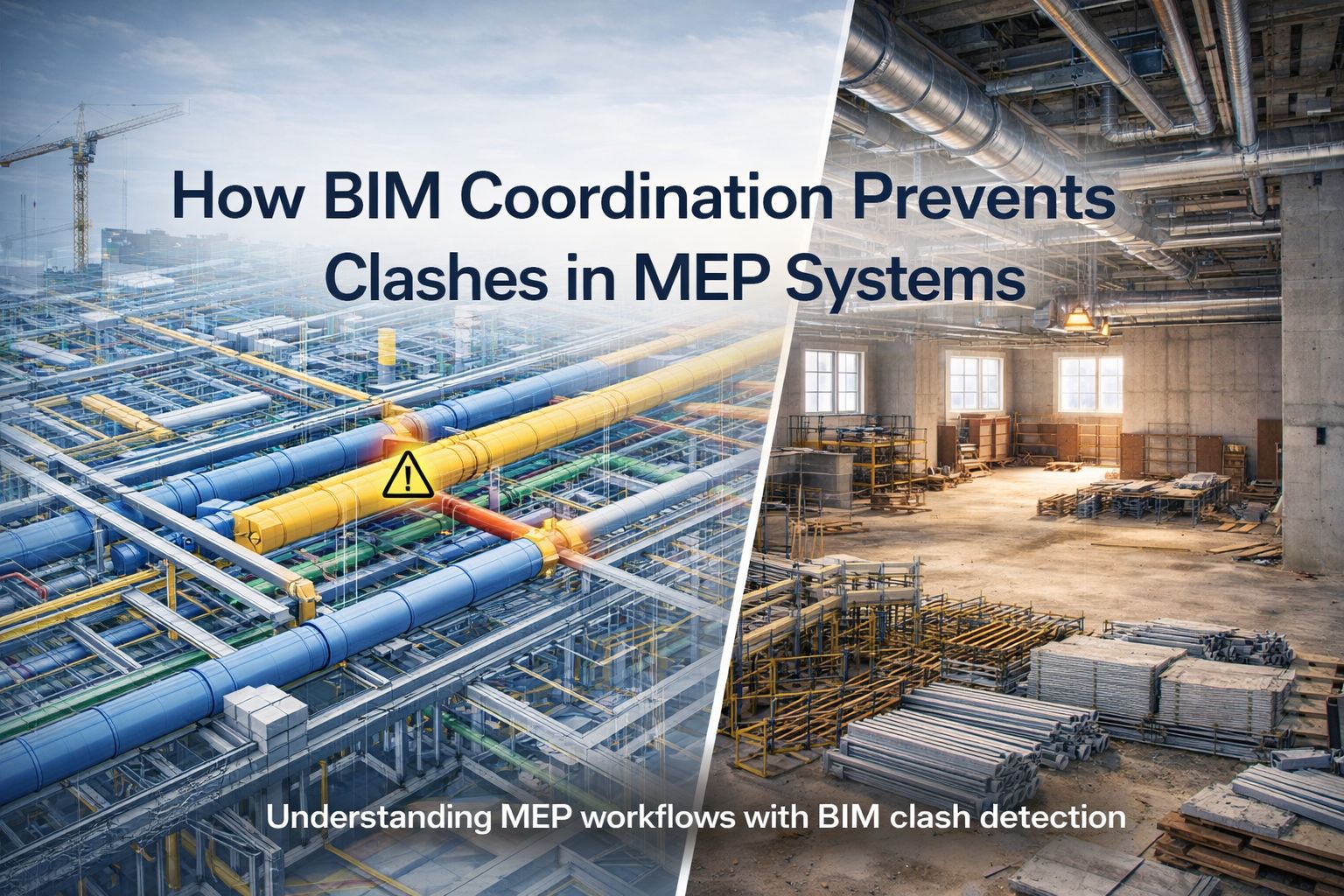
How BIM Coordination Prevents Clashes in MEP Systems
Modern construction projects involve multiple technical systems working inside the same limited building space. Mechanical ducts, electrical cable trays, plumbing pipes, fire protection lines, and structural elements often pass through ceilings, shafts, plant rooms, and service corridors at the same time. When these systems are designed separately without coordination, they often clash during installation.
This is one of the biggest reasons for site delays, rework, and cost increases in commercial construction.
BIM coordination solves this problem by combining all disciplines into one intelligent digital model before construction starts. BIM, or Building Information Modeling, allows architects, structural engineers, and MEP teams to detect clashes early, review installation space, and correct conflicts before materials reach the site.
In today’s construction environment, BIM coordination has become one of the most important tools for reducing MEP errors because it helps teams identify clashes digitally rather than physically during installation. Recent research shows that BIM-based clash detection significantly improves coordination efficiency and reduces costly rework when compared with isolated 2D workflows.
What Is BIM Coordination in Construction?
BIM coordination is the process of combining models from different disciplines into one shared digital environment so that conflicts between systems can be identified and resolved.
A BIM model usually includes:
•architectural model
•structural model
•electrical model
•fire protection model
When these models are merged, every system becomes visible inside the same building space.
This helps teams understand whether systems fit properly before installation begins.
Why MEP Systems Clash So Often
MEP systems are designed by different engineering teams.
Each discipline focuses on its own requirements:
•HVAC needs duct space
•electrical needs tray routing
•plumbing needs slope and vertical drops
•fire systems need dedicated pipe routes
The problem is that all these systems compete for the same ceiling space.
Without coordination, clashes happen such as:
•duct crossing beam
•cable tray blocking pipe route
•sprinkler line touching duct
•pipe interfering with equipment clearance
These clashes often remain hidden in 2D drawings.
How BIM Detects Clashes Before Construction
BIM software compares all systems inside a 3D model.
The software automatically identifies conflict points where objects overlap.
This process is called clash detection.
The most common tools used include:
•Autodesk Navisworks
•Autodesk Revit
•Solibri
These tools highlight exact clash locations.
Instead of discovering a clash on site, engineers can solve it during design review.
Modern BIM tools also allow grouped clash reports, which helps teams prioritize critical issues faster. 
Types of Clashes Found in MEP Coordination
There are mainly three types of clashes.
1. Hard Clash
A hard clash happens when two physical elements occupy the same space.
Example:
A duct passes directly through a beam.
2. Soft Clash
A soft clash happens when required clearance is missing.
Example:
An electrical panel has no maintenance access.
3. Workflow Clash
A workflow clash happens when installation sequence causes conflict.
Example:
Pipe installation blocks later cable tray access.
How BIM Coordination Process Works
The BIM coordination process follows clear stages.
Step 1: Model Collection
Each discipline submits its own model.
Step 2: Model Federation
All models are combined into one shared file.
Step 3: Clash Detection
Software checks intersections.
Step 4: Clash Review Meeting
Teams discuss which system should move.
Step 5: Model Revision
Updated models are issued.
Step 6: Coordinated Drawing Release
Final coordinated shop drawings are prepared.
Why BIM Coordination Reduces Rework
Without BIM, clashes appear during installation.
That leads to:
•material cutting
•rerouting
•ceiling demolition
•delayed inspections
With BIM, corrections happen digitally.
That reduces:
•labor waste
•material waste
•project delay
•approval problems
Research in 2024 confirms that identifying clashes during design stage directly improves cost efficiency and shortens project timelines.
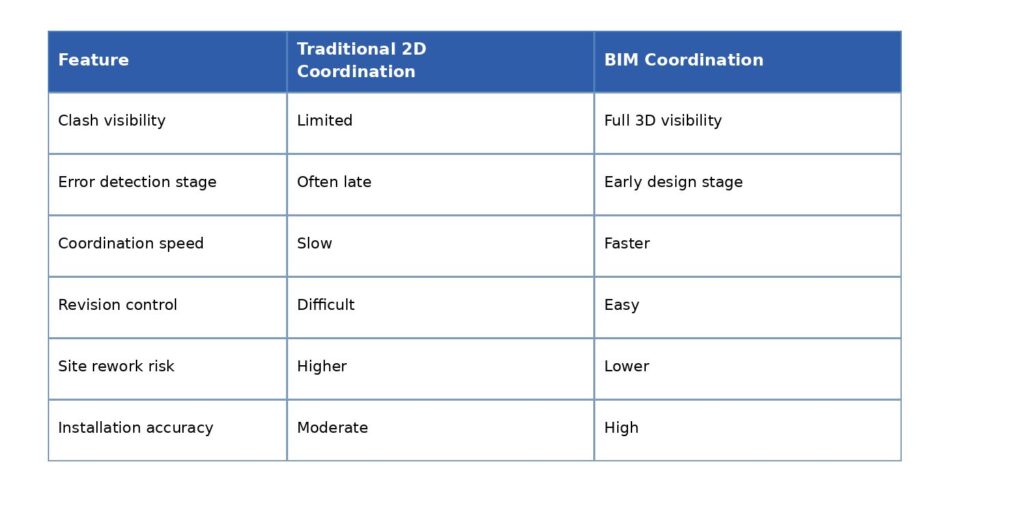
Traditional Coordination vs BIM Coordination
Why BIM Is Especially Important for HVAC Systems
HVAC systems usually occupy the largest ceiling space.
Ductwork often clashes first because:
•ducts are large
•branches change direction often
•equipment needs clearance
BIM helps HVAC teams test routing before fabrication begins.
This prevents fabricated ducts from becoming unusable on site.
BIM Coordination for Electrical and Plumbing Systems
Electrical systems need routing flexibility.
Plumbing needs slope.
These two often conflict because slope reduces available ceiling depth.
BIM helps teams solve:
•tray elevation
•pipe drops
•sleeve positions
•riser alignment
Clash Resolution Is Not Just Software Work
Software only identifies clashes.
Engineers still decide solutions.
A clash report may show 300 clashes.
Not all are critical.
Teams must decide:
•which system moves
•which system has priority
•which route is practical
That is why BIM meetings remain essential.
Common BIM Coordination Mistakes
Even BIM projects can fail if coordination is weak.
Common mistakes:
•incomplete models
•wrong levels
•outdated revisions
•excessive false clashes
•missing clearance rules
This is why disciplined model management matters.
BIM Coordination in Large Commercial Projects
Large projects benefit most because systems are dense.
Typical projects:
•hospitals
•malls
•airports
•towers
•industrial plants
In these projects, manual coordination becomes unreliable.
BIM Coordination in Qatar Construction Projects
In Qatar, BIM coordination is increasingly important because projects involve:
•high service density
•authority approvals
•large HVAC loads
•fast-track schedules
For complex projects, using Best BIM modeling services in Qatar improves model quality and helps reduce MEP clashes before site execution.
Future of BIM Clash Detection
BIM is moving beyond standard clash reports.
Current developments include:
•AI-assisted clash prediction
•automated clash grouping
•digital twin integration
•4D installation sequencing
Recent studies show machine learning models are now improving clash prediction accuracy inside BIM workflows.
Conclusion
BIM coordination prevents clashes in MEP systems by allowing all disciplines to work inside one coordinated digital model before construction begins.
Instead of solving conflicts on site, teams solve them in design stage.
This leads to:
•fewer installation errors
•lower rework cost
•faster project delivery
As construction projects become more complex, BIM coordination is no longer optional- it is becoming a standard requirement for reliable MEP execution.


5 Comments
phjilibett
March 24, 2026
If you are looking for a fair and honest gaming site, phjilibett is the way to go. Five stars from me!
thuok168
March 24, 2026
I have been playing online for quite some time and this platform stands out for its genuine fairness and fast processing. The support team is super friendly and always ready to help with any small hiccups. Bonuses are clear and easy to claim without confusing terms. You really should test it out for a weekend and see the difference yourself. thuok168
bd133bet
March 24, 2026
The bonuses on this site are insane. I managed to hit a decent streak last night and the withdrawal was processed almost instantly. Cheers to bd133bet
bet939gamelogin
March 24, 2026
The login process is so quick and easy. I love how stable the connection is even during peak hours. Just use bet939gamelogin and you will see what I mean.
bd17777bet
March 24, 2026
The odds here are actually decent compared to other sites I have used. The payout process is quick and transparent too. Definitely trust bd17777bet for your bets.