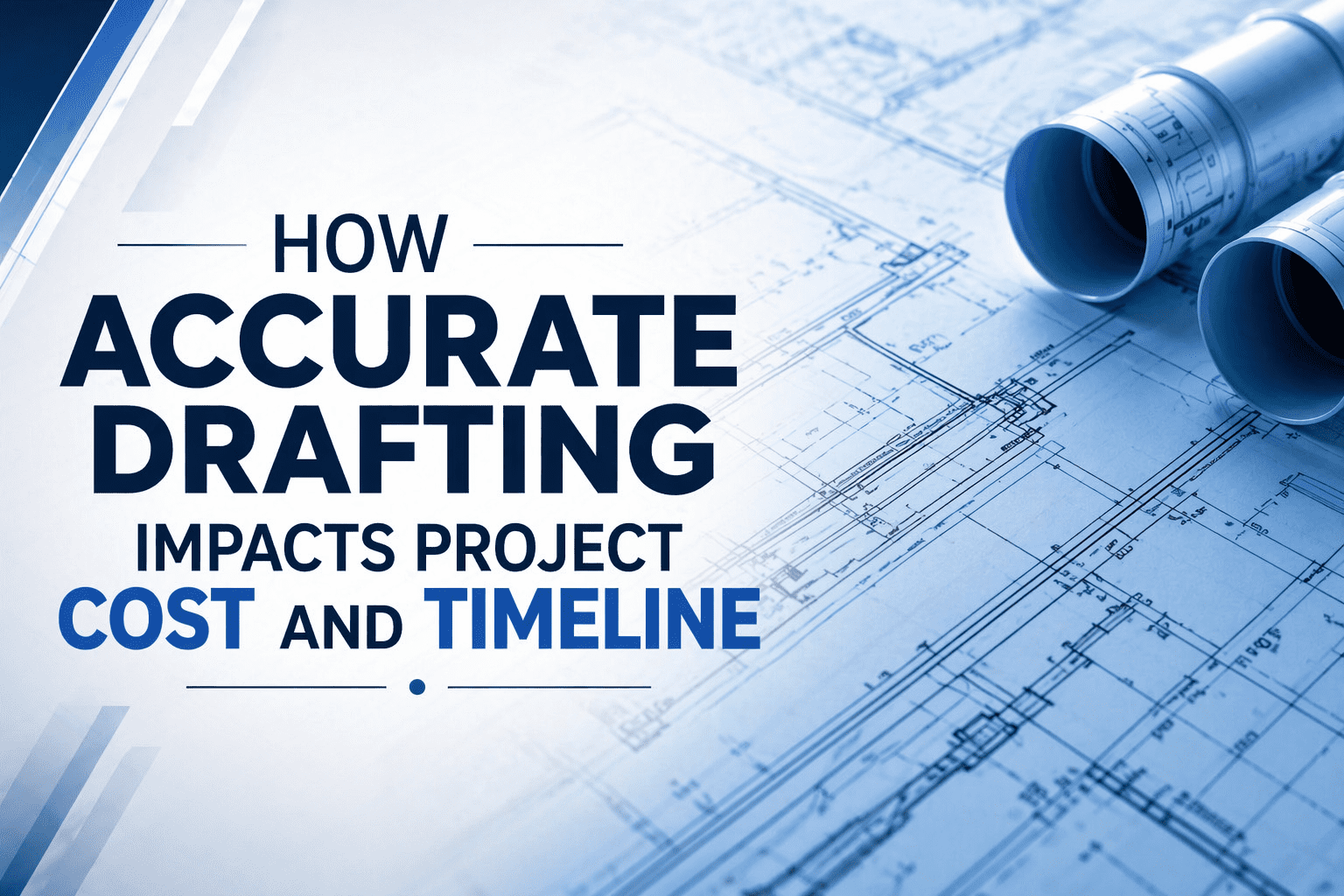
How Accurate Drafting Impacts Project Cost and Timeline
In construction and engineering projects, drafting is often treated as a technical documentation step, but in reality, it directly influences how much a project costs and how long it takes to complete.
A drawing is not simply a visual instruction. It controls procurement, site execution, coordination, approvals, fabrication, installation, and future revisions. When drawings are accurate, teams move faster because decisions are clear. When drawings contain errors, even small mistakes can create expensive consequences across multiple stages of a project.
Today, with tighter deadlines, stricter compliance standards, and increasingly complex buildings, accurate drafting has become one of the strongest cost-control tools available in construction.
Whether a project involves architecture, structural engineering, HVAC, electrical systems, plumbing, or full multidisciplinary coordination, drafting quality determines how efficiently teams can work.
Recent industry studies also show that digital coordination methods reduce documentation errors, lower repetitive work, and shorten project duration when compared with poorly managed traditional workflows. Research comparing CAD and BIM workflows found that improved digital accuracy can reduce document errors by up to 64% and reduce rework significantly during execution.
Why Drafting Accuracy Matters From the Start
A project begins making financial decisions long before construction starts.
Every quantity estimate, procurement plan, material schedule, and contractor scope depends on the drawing set.
If dimensions are wrong, missing, or inconsistent, cost calculations immediately become unreliable.
For example:
- wrong beam dimensions affect steel quantity
- incorrect slab openings affect MEP routing
- inaccurate wall layouts affect finishing quantities
- unclear sections affect fabrication
At this stage, one drafting error can multiply through several departments before anyone notices it.
This is why drafting accuracy is not only a design issue—it is an early budget protection mechanism.
How Inaccurate Drawings Increase Project Cost
The biggest financial impact of inaccurate drafting comes through rework.
Rework means completed work must be removed, adjusted, or rebuilt because drawings did not match site reality or other systems.
Common cost impacts include:
- material wastage
- extra labour hours
- equipment idle time
- delayed subcontractor work
- repeated approvals
For example, if an HVAC duct route clashes with a structural beam and the problem is discovered during installation, several trades become affected immediately.
The duct contractor stops.
The structural team may need adjustment approval.
The electrical team may lose routing space.
The schedule shifts.
The cost increases instantly.
Studies on BIM-based coordination consistently show that early clash detection reduces these expensive field corrections because conflicts are solved before reaching site execution.
Accurate Drafting Reduces Delays During Construction
Construction delays rarely begin with dramatic failures.
They usually begin with unclear documentation.
When site teams cannot understand a detail clearly, they stop and ask questions.
This creates:
- RFIs (Requests for Information)
- consultant clarification delays
- redesign cycles
- waiting periods between trades
Even a one-day delay on one drawing clarification can affect multiple downstream activities.
Accurate drafting reduces this because drawings answer questions before they arise.
When dimensions, sections, references, and annotations are complete, site execution becomes continuous.
This improves sequencing and reduces idle labour time.
Why Revision Control Is Critical
Modern projects rarely stay unchanged from start to finish.
Clients revise layouts.
Authorities request modifications.
Engineers update systems.
If drafting is not managed carefully, old and new versions begin circulating together.
That creates one of the most expensive hidden risks in construction: teams building from outdated drawings.
Accurate drafting includes strict revision control:
- clear revision numbering
- date tracking
- issue logs
- updated cloud markings
- controlled distribution
Without revision discipline, even technically correct drawings can still cause cost overruns.
Drafting Accuracy Improves Procurement Decisions
Procurement depends entirely on reliable drawing information.
Materials are ordered based on:
- quantities
- dimensions
- specifications
- equipment schedules
If drawings are inaccurate, procurement orders become inaccurate too.
This creates two expensive outcomes:
Over-ordering
More material than required increases storage cost and waste.
Under-ordering
Material shortages stop work and force urgent purchasing.
Urgent procurement usually means:
- higher prices
- limited supplier options
- delayed delivery
Accurate drafting helps procurement teams order exactly what the project requires.
How Accurate Drafting Improves Multidisciplinary Coordination
Modern buildings involve multiple technical systems working inside limited space.
Architecture, structure, mechanical, electrical, plumbing, fire protection, and specialist systems all depend on shared drawing accuracy.
A small drafting inconsistency between disciplines creates conflict immediately.
Examples include:
- ceiling levels not matching duct routes
- electrical trays crossing pipe slopes
- wall openings missing from structural sheets
Accurate drafting prevents these problems by maintaining alignment across disciplines.
This is why companies increasingly depend on digital coordination before construction begins.
CAD and BIM Both Improve Accuracy When Used Correctly
CAD remains the foundation of precise construction documentation.
It allows:
- accurate dimensions
- controlled layers
- fast revision updates
- clear plotting standards
BIM adds another level by improving coordination through intelligent models.
BIM allows teams to:
- detect clashes early
- update all views automatically
- verify installation space
- improve sequencing
A recent study found BIM workflows reduce project cost, duration, and repeated drafting compared with traditional fragmented documentation systems.
However, tools alone do not create accuracy.
Accuracy depends on disciplined drafting methods.
Why Small Drafting Errors Become Large Financial Problems
Many costly project failures begin with small mistakes that seem harmless early.
Examples:
- wrong annotation
- missing elevation mark
- incorrect scaling
- unclear section reference
Individually, these seem minor.
But once site teams interpret them differently, the cost multiplies.
A wrong level mark can affect:
- slab casting
- MEP penetrations
- facade alignment
- finishing work
That is why small drafting mistakes are often more dangerous than obvious design problems—they remain unnoticed until execution.
Accurate Drafting Supports Faster Authority Approvals
Authorities and consultants review drawing quality very carefully.
Poor drafting leads to:
- rejected submissions
- repeated comments
- delayed permits
Common rejection reasons include:
- inconsistent dimensions
- unclear notes
- missing references
- poor sheet organization
Accurate drafting speeds approval because reviewers trust clear documentation faster.
This directly affects project timeline because approvals control site progress.
Why Outsourced Drafting Often Improves Cost Control
Many firms now outsource drafting because internal teams often become overloaded during peak project phases.
Outsourced specialists usually maintain:
- dedicated drafting focus
- faster revisions
- stronger template discipline
- fewer production errors
This helps companies protect internal engineering time for design decisions while production quality remains consistent.
That is one reason many engineering firms rely on CAD Drafting Services in Qatar when project volume increases or deadlines tighten.
Long-Term Cost Benefits Beyond Construction
Accurate drafting continues creating value even after project completion.
Final drawings support:
- maintenance
- facility upgrades
- future renovations
- asset documentation
Poor as-built drawings create future cost because facility teams cannot trust existing information.
Accurate final documentation reduces future investigation cost.
How Accurate Drafting Protects Project Profitability
Profit margins in construction are often tighter than expected.
A few avoidable drawing mistakes can remove profit quickly.
Accurate drafting protects profitability because it reduces:
- claims
- variation disputes
- contractor conflicts
- repeated fabrication
Many successful projects are not profitable because of dramatic innovation—they are profitable because technical documentation stayed reliable throughout execution.
Conclusion
Accurate drafting plays a direct role in controlling construction cost, reducing delays, and improving decision-making across every stage of a project. When drawings are clear, coordinated, and technically reliable, teams can avoid unnecessary revisions, protect procurement accuracy, and aintain smoother execution on site. As projects continue becoming more complex, many firms increasingly depend on CAD Drafting Services in Qatar to maintain high documentation standards and ensure that project timelines and budgets remain under control.