BIM LOD 100 to LOD 500 – Which Level Does Your Qatar Project Actually Need?
In today’s construction industry, BIM (Building Information Modeling) is widely used across design, coordination, and execution stages. However, one of the most misunderstood aspects of BIM is LOD (Level of Development).
Many project teams believe that using the highest LOD always gives better results. In reality, that approach often leads to wasted time, increased cost, and unnecessary complexity.
The real value of BIM lies in using the right level of detail at the right stage.
This becomes especially important in Qatar, where projects involve dense MEP systems, strict authority approvals, and fast-track construction schedules.
So instead of asking “What is LOD?”, the better question is:
What Is BIM LOD (Level of Development)?
LOD stands for Level of Development, which defines how much detail and reliability a BIM model contains at different stages of a project.
It is not just about visual detail. It also defines:
- how accurate the model is
- how reliable the data is
- whether it can be used for decisions or construction
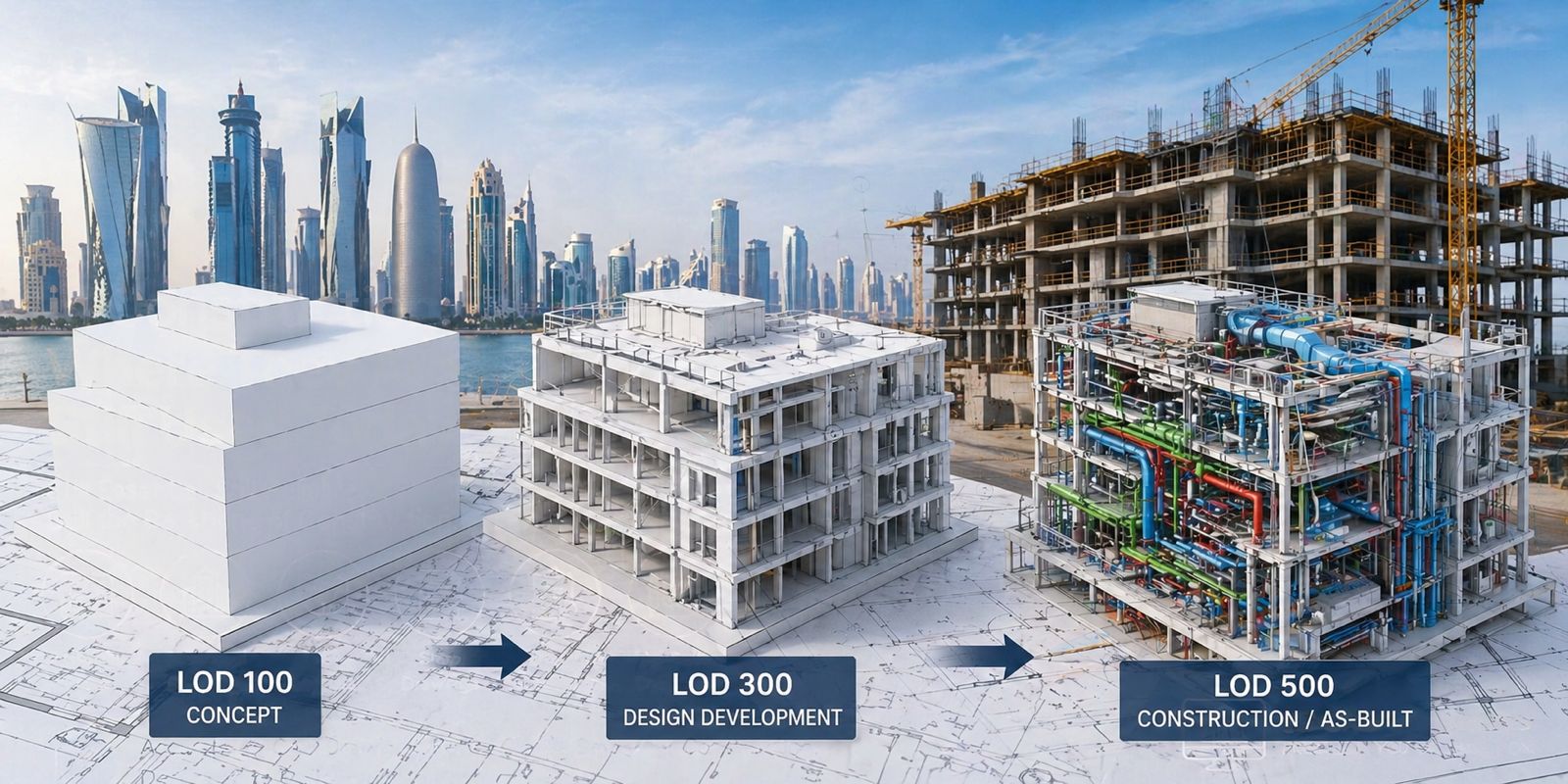
LOD levels range from LOD 100 to LOD 500, moving from concept to actual built condition.
Why LOD Is Critical in Construction Projects
LOD directly affects:
- coordination accuracy
- construction efficiency
- project cost
- approval timelines
- installation quality
If LOD is not properly defined:
- teams make wrong assumptions
- clashes increase
- rework becomes unavoidable
- project timelines slip
LOD acts as a communication standard that helps all stakeholders understand what information is available at each stage.
LOD 100 – Concept Stage
LOD 100 represents the earliest stage of design.
At this level, the model shows:
- basic building shape
- general layout
- approximate size and location
Elements are often represented using simple geometry or symbolic forms.
When to use:
- feasibility studies
- concept presentations
- early-stage planning
Key limitation:
No precise dimensions or installation decisions can be made.
LOD 200 – Schematic Design
LOD 200 introduces more detail compared to LOD 100.
It includes:
- approximate geometry
- general system layouts
- basic spatial relationships
This level allows early coordination and rough quantity estimation.
When to use:
- preliminary design
- early MEP routing
- budgeting
Key limitation:
Still not accurate enough for construction.
LOD 300 – Detailed Design
LOD 300 is where BIM becomes truly useful for execution.
At this level:
- elements have accurate size and location
- dimensions are measurable
- systems are properly defined
You can extract reliable information directly from the model.
When to use:
- design development
- construction drawings
- coordination review
Why it matters:
LOD 300 is the minimum required level for reliable construction planning.
LOD 350 – Coordination Stage (Critical but Often Ignored)
LOD 350 focuses on how systems interact.
It includes:
- system connections
- interface details
- supports and clearances
This level ensures that different systems fit together without conflict.
When to use:
- clash detection
- coordination meetings
- multi-discipline alignment
Why it matters:
Most construction issues are solved at this stage—not on site.
LOD 400 – Fabrication Level
LOD 400 includes full construction-level detail.
It contains:
- fabrication details
- installation specifications
- exact components
Models at this level are used for:
- shop drawings
- prefabrication
- installation planning
When to use:
- contractor execution
- manufacturing
- detailed construction
Key insight:
Not every project needs full LOD 400 across all systems.
LOD 500 – As-Built Model
LOD 500 represents the actual built condition.
It includes:
- verified installation data
- real dimensions
- asset information
This model is used for:
- facility management
- maintenance
- future upgrades
LOD 500 reflects what is physically constructed, not just designed.
Which LOD Does Your Qatar Project Actually Need?
Many projects fail because they either:
- use too little detail → causing errors
- use too much detail → wasting time
Practical LOD Strategy
| Project Stage | Recommended LOD |
| Concept | LOD 100 |
| Schematic | LOD 200 |
| Design | LOD 300 |
| Coordination | LOD 350 |
| Construction | LOD 400 |
| Handover | LOD 500 |
Key takeaway:
LOD should progress gradually, not be applied fully at the beginning.
Common Mistakes in LOD Planning
1. Over-modeling too early
Creating high-detail models during early design wastes effort.
2. Skipping coordination level
Ignoring LOD 350 leads to clashes during construction.
3. Using LOD 200 for execution
This causes inaccurate installation and rework.
4. No LOD definition in contracts
Different teams assume different levels → leads to conflict.
Why LOD Is More Important in Qatar Projects
Qatar projects have unique challenges:
- high HVAC demand
- dense ceiling services
- strict authority approvals
- fast-track deadlines
Because of this, LOD planning directly affects:
- approval speed
- site coordination
- installation accuracy
- project cost
This is why many contractors rely on experienced BIM teams to manage LOD correctly.
Role of BIM Teams in Managing LOD
LOD is not just about modeling—it is about strategy.
A professional BIM team ensures:
- correct LOD at each stage
- coordination across disciplines
- clash detection before construction
- accurate documentation
Without proper LOD control, BIM becomes a visual tool—not a construction solution.
When Should You Use High LOD?
Use LOD 400 when:
- fabrication is required
- prefabrication is involved
- installation precision is critical
Use LOD 500 when:
- facility management is required
- lifecycle maintenance is planned
Avoid high LOD when:
- design is still changing
- decisions are not finalized
Future of BIM LOD
LOD is evolving with new technologies:
- AI-based clash detection
- automated modeling
- digital twins
- real-time BIM updates
However, the principle remains unchanged:
Conclusion
BIM LOD is not about adding maximum detail-it is about using the right level of detail at each stage of a project.
From LOD 100 concept models to LOD 500 as-built data, each level serves a specific purpose in improving clarity, coordination, and execution.
For Qatar projects, where complexity and coordination demands are high, selecting the correct LOD is critical for reducing rework, improving accuracy, and ensuring smooth construction workflows.
By working with experienced teams that provide BIM modeling services in Qatar, project stakeholders can ensure that the right LOD is applied at the right time-leading to better decision-making, efficient execution, and long-term project success.