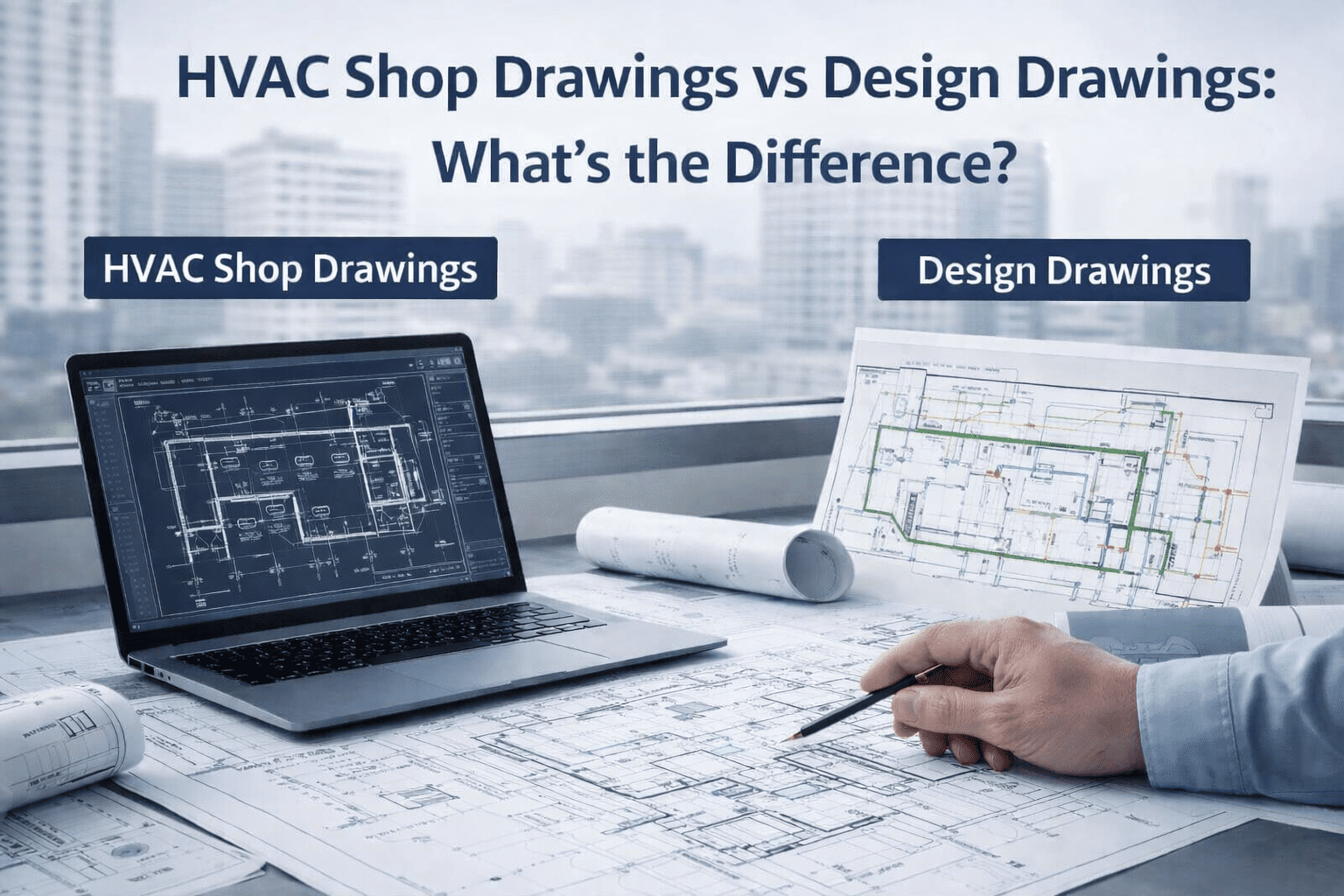
HVAC Shop Drawings vs Design Drawings: What’s the Difference?
In HVAC projects, many delays happen because teams assume design drawings and shop drawings serve the same purpose. They do not.
Both drawings are important, but they are created at different stages, by different teams, and for different decisions.
A design drawing explains what the HVAC system should achieve inside a building. A shop drawing explains exactly how that system will be fabricated, coordinated, approved, and installed on site.
This difference becomes critical in commercial projects because HVAC systems must fit inside limited ceiling space while coordinating with structural beams, electrical trays, plumbing lines, and fire protection services.
If design drawings remain general and shop drawings are missing, contractors often face:
- duct clashes during installation
- ceiling height problems
- incorrect duct sizes at site
- delayed approvals
- fabrication changes after installation starts
That is why HVAC shop drawings are no longer treated as optional technical support documents. In modern construction, they are part of execution control.
What Is an HVAC Design Drawing?
An HVAC design drawing is the engineer’s primary technical plan for how heating, ventilation, and air conditioning systems should function inside the building.
Its main purpose is to define design intent.
It usually shows:
- major duct routes
- equipment locations
- air handling unit placement
- diffuser positions
- airflow requirement
- chilled water connections
- ventilation concept
A design drawing tells the project team:
What system is required to achieve thermal comfort and ventilation performance?
It is mainly prepared during design development before construction begins.
These drawings are used for:
- consultant approval
- tender pricing
- initial project coordination
- permit submissions
Design drawings normally do not contain fabrication-level installation detail.
What Is an HVAC Shop Drawing?
An HVAC shop drawing is a more detailed drawing created after design approval and before installation starts.
Its purpose is to convert design intent into exact buildable instructions.
It usually includes:
- exact duct dimensions
- fitting details
- duct elevations
- support locations
- damper positions
- access doors
- insulation space
- fabrication references
- coordination with other services
A shop drawing answers:
How exactly will this HVAC system be installed inside the actual building?
This is the drawing used by:
- duct fabricators
- site engineers
- installers
- subcontractors
- consultants during technical review
Without shop drawings, site execution becomes guesswork.
The Core Difference in One Simple Line
The easiest way to understand the difference is:
Design drawing defines the system. Shop drawing defines execution.
Design drawing says:
- supply duct here
- diffuser here
- AHU here
Shop drawing says:
- duct size 800×500
- bottom level +3.250
- turning vane required
- access panel required here
- hanger spacing here
This is why shop drawings always contain more technical detail than design drawings.
Who Prepares Each Drawing?
This is another major difference.
HVAC Design Drawings Are Prepared By:
- mechanical consultants
- design engineers
- MEP consultants
HVAC Shop Drawings Are Prepared By:
- HVAC contractors
- drafting specialists
- fabrication teams
- BIM coordination teams
The design consultant defines performance.
The contractor defines execution detail.
This separation exists because site conditions become clearer only after structural and architectural coordination progresses.
Why Design Drawings Are Not Enough for Installation
Many people assume a detailed design drawing is enough.
It is not.
Because design drawings usually do not fully resolve:
- beam interference
- duct offsets
- exact fitting types
- support spacing
- coordination with cable trays
- false ceiling limitations
For example:
A design drawing may show a duct crossing a corridor.
But on site:
- beam depth reduces height
- sprinkler line crosses same path
- lighting fixture occupies same ceiling zone
Only shop drawing resolves this.
What HVAC Shop Drawings Add That Design Drawings Usually Do Not Show
Shop drawings add execution information that design drawings normally leave open.
This includes:
Exact Duct Sizes After Coordination
Design drawing may show main duct concept.
Shop drawing confirms:
- final width
- final height
- actual reduction pieces
Fittings and Connections
Shop drawings define:
- elbow type
- offset detail
- transition type
- branch takeoff method
Elevation Information
This is critical.
Without elevation:
site installation fails.
Shop drawings show:
- bottom duct level
- top clearance
- slab relation
Support and Hanger Logic
Fabrication teams need hanger reference.
Design drawings rarely include this fully.
Access Zones
Shop drawings show where access is needed for:
- fire dampers
- balancing dampers
- VAV boxes
Why Consultants Reject HVAC Drawings During Approval
Many HVAC submissions fail because teams submit design-level detail instead of shop-level detail.
Consultants usually reject drawings when:
- duct elevations missing
- service clashes unresolved
- equipment clearance ignored
- ceiling conflict not addressed
The drawing may look complete visually but still fail technically.
Approval depends on buildability.
HVAC Shop Drawings Must Match Actual Site Conditions
This is where shop drawings become critical.
Because actual construction conditions often differ slightly from design assumptions.
Typical site differences include:
- beam depth variation
- shaft opening change
- reflected ceiling adjustment
- equipment relocation
Shop drawings must reflect actual installable conditions before fabrication starts.
That is why field verification matters before final issue.
How BIM Changes HVAC Shop Drawing Quality
Today many projects generate HVAC shop drawings through BIM coordination.
This improves accuracy because BIM identifies:
- hard clashes
- service overlap
- impossible duct routes
- maintenance conflicts
BIM-supported shop drawings are stronger because they use real coordinated space.
This reduces revision cycles significantly.
Recent HVAC BIM workflows increasingly automate parts of this detailing process because manual correction consumes large drafting time.
Which Drawing Is Used for Fabrication?
Only shop drawings are used for fabrication.
Fabricators cannot manufacture ducts from design drawings safely because fabrication requires:
- exact size
- exact fitting type
- reinforcement details
- pressure class
If fabrication starts from design drawing only:
errors are almost guaranteed.
Which Drawing Is Used on Site During Installation?
Site teams mainly rely on shop drawings.
Because installers need:
- dimensions
- levels
- connection detail
- sequence clarity
Design drawings remain reference documents.
Shop drawings become execution documents.
Common Mistake Contractors Make
A frequent mistake is approving duct fabrication before final coordination.
This creates:
- refabrication cost
- ceiling redesign
- delay in installation
Strong contractors never release fabrication before shop drawing approval.
Why Shop Drawings Save Money
Many contractors think shop drawings add cost.
Actually they reduce cost because they prevent:
- material waste
- wrong fabrication
- site rework
- consultant revisions
The saving is often much larger than the drafting effort itself.
Why HVAC Projects Now Depend on Specialist Drafting Teams
Modern buildings have:
- tighter ceiling spaces
- more services
- faster deadlines
- stricter approval cycles
That means HVAC shop drawings now require specialist drafting skill.
For complex projects, working with the Best HVAC Company in Qatar often means choosing teams that understand both design logic and execution detail before fabrication starts.
Conclusion
HVAC design drawings and HVAC shop drawings are connected, but they are not interchangeable.
Design drawings define what the HVAC system must achieve.
Shop drawings define how that system will actually be built inside the project.
The strongest HVAC workflow always moves in this order:
design → coordination → shop drawing → approval → fabrication → installation
When that sequence is followed correctly, projects move faster, approvals become smoother, and installation errors reduce significantly.
That is why professional drafting support has become a critical part of modern HVAC execution