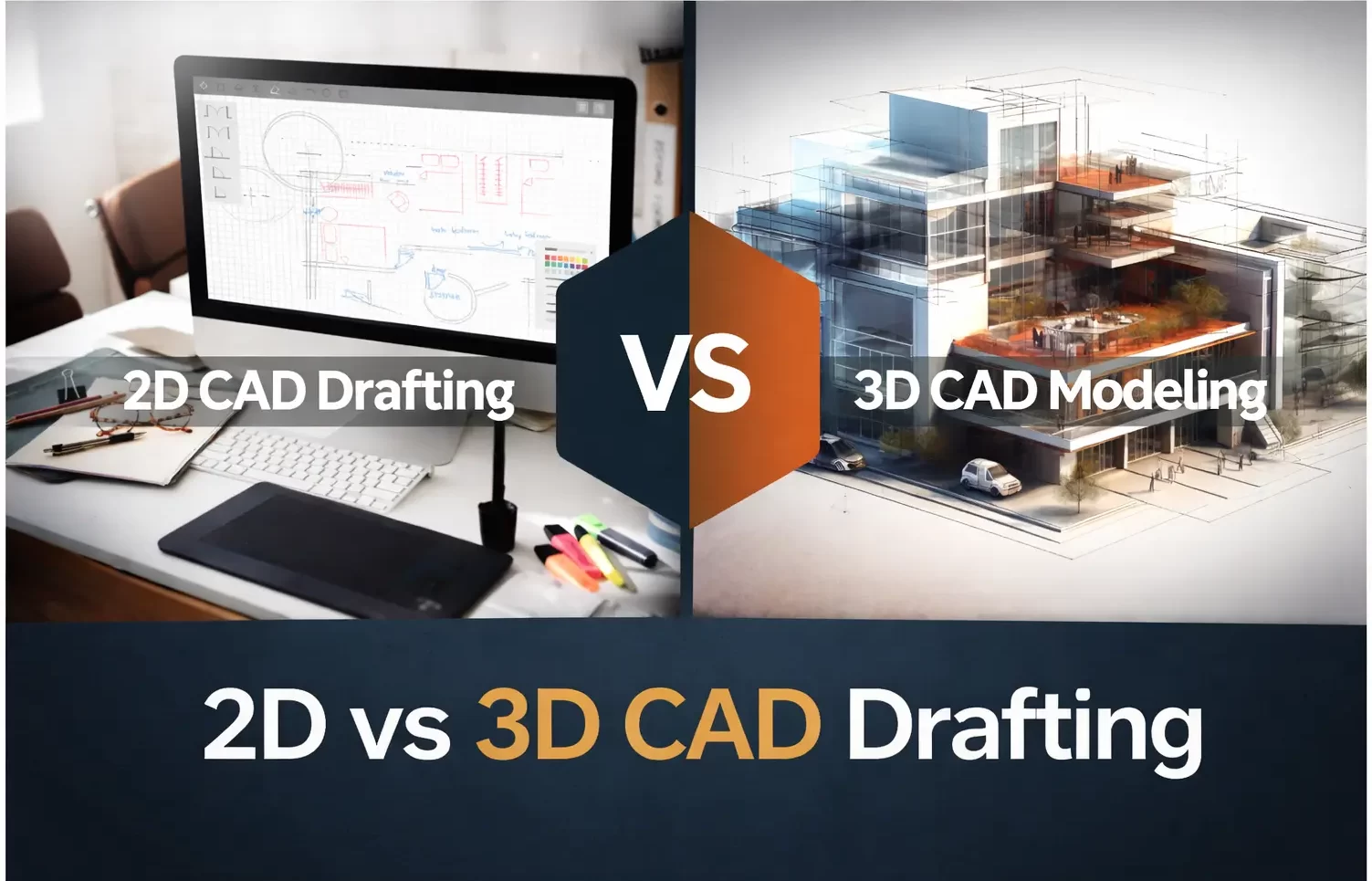
2D vs 3D CAD Drafting: Which Delivers Better Results for Your Project?
Every construction or engineering project in Qatar starts the same way — with drawings. But not all drawings are created equal. Choosing between 2D and 3D CAD drafting isn’t a design preference. It’s a strategic project decision that affects approval timelines, construction accuracy, coordination, and ultimately cost.
Qatar’s building sector is fast-paced and highly regulated. Municipality submissions, authority approvals, and contractor coordination demand precise technical documentation. This is why demand for professional CAD drafting services in Qatar has grown sharply. But many clients still ask the same question:
“Do I need 2D drafting, 3D drafting, or both?”
Let’s answer that clearly.
Understanding CAD Drafting in Simple Terms
CAD drafting is the process of converting ideas, sketches, and concepts into technical digital drawings used for construction, fabrication, and installation. These drawings guide architects, engineers, contractors, and approval authorities.
There are two primary methods: 2D drafting and 3D drafting.
What is 2D CAD Drafting?
2D CAD drafting produces flat technical drawings based on length and width. Common 2D drawings include:
Floor plans
Elevations
Sections
Site layouts
Construction details
These are the standard documents required for authority submissions and construction referencing. Most approval bodies in Qatar still rely on 2D drawings as mandatory documentation. That’s why 2D CAD drafting services in Qatar remain essential for nearly every project.
2D drafting is fast, cost-effective, and ideal for producing precise technical layouts.
What is 3D CAD Drafting?
3D CAD drafting adds depth. Instead of flat drawings, it creates a three-dimensional digital model of the building or system. You can rotate it, inspect components, and see how everything fits together before construction begins.
3D drafting is widely used for:
Building visualization
Structural coordination
MEP and HVAC routing
Clash detection
Client presentations
Modern engineering firms and contractors in Qatar increasingly rely on 3D CAD drafting services to avoid costly on-site conflicts.
Key Differences Between 2D and 3D CAD Drafting
Visualization
2D drawings require technical knowledge to interpret. A trained engineer sees a floor plan and understands the space. A project owner usually doesn’t.
3D models solve this instantly. Clients can see the building, interior spaces, and system layouts exactly as they will appear. This improves communication and reduces misunderstanding.
If client approval and visualization matter, 3D drafting is the stronger option.
Accuracy and Clash Detection
2D drafting relies on coordinating multiple separate drawings. Architectural, structural, and MEP plans must be cross-checked manually. Human error is common.
3D drafting integrates all disciplines into one model. Software automatically detects clashes — for example, a duct passing through a beam. Fixing these issues digitally is cheap. Fixing them on-site is expensive.
This is why large construction projects in Qatar increasingly demand 3D coordination before execution.
Workflow and Project Speed
2D drafting is faster for straightforward projects. Small residential buildings, shop layouts, and basic renovations can move quickly using 2D documentation alone.
3D drafting takes longer at the modeling stage. But it dramatically reduces revisions during construction. Fewer site changes means faster project completion overall.
Speed at the start vs speed at the finish — that’s the trade-off.
Cost Comparison: 2D vs 3D CAD Drafting in Qatar
Let’s be direct.
2D drafting has a lower upfront cost. It requires less modeling time and simpler software workflows. For budget-sensitive or small-scale projects, this makes sense.
3D drafting costs more initially. But it prevents:
On-site rework
Material wastage
Installation errors
Approval resubmissions
For medium and large projects, 3D drafting often saves more money than it costs.
The smartest approach used by many CAD drafting services in Qatar is a hybrid workflow — 3D models for coordination and visualization, 2D drawings for authority submission and construction sets.
Where Each Method Works Best in Qatar
Architectural Projects
2D drafting produces floor plans, elevations, and submission drawings.
3D drafting helps clients visualize the building, review façade options, and approve layouts faster.
Most architecture firms in Doha use both together.
Structural Engineering Projects
2D drafting is used for:
Structural layouts
Reinforcement detailing
Beam and column schedules
3D drafting helps identify structural conflicts with MEP and architectural elements before construction begins.
MEP and HVAC Projects
This is where 3D drafting dominates.
Mechanical ducts, electrical trays, plumbing lines, and fire systems compete for space. Without 3D coordination, clashes are guaranteed.
Professional MEP CAD drafting services in Qatar rely heavily on 3D models to ensure smooth installation on site.
Which CAD Drafting Option Should You Choose?
Choose 2D CAD drafting if:
The project is small or simple
Budget is limited
You need authority submission drawings only
Visualization is not critical
Choose 3D CAD drafting if:
The project is large or complex
Multiple engineering disciplines overlap
Client visualization is important
Clash-free construction is required
Choose a hybrid approach if:
You want cost control and high accuracy
You need 3D coordination and 2D submission drawings
A reliable CAD drafting partner will recommend the right approach — not just the expensive one.
Why Hire Professional CAD Drafting Services in Qatar
Local Compliance Knowledge
Qatar’s municipality and authority submission standards are strict. Drawing layer formats, annotation styles, title blocks, and scale requirements must match local regulations.
Local CAD drafting experts understand these standards. This reduces submission rejections and approval delays.
Faster Project Approvals
Well-structured CAD drawings lead to quicker reviews. Poorly formatted drawings get returned. That costs time and money.
Experienced CAD drafting services in Qatar deliver approval-ready documentation from the first submission.
Clear Communication
Accurate drawings mean fewer misunderstandings between:
Architects
Engineers
Contractors
Clients
Clear communication keeps projects on schedule and avoids disputes.
Common Mistakes Clients Make
Many project owners make predictable errors:
Choosing only 2D drafting for complex projects
Paying for 3D drafting when the project doesn’t need it
Hiring low-cost drafters unfamiliar with Qatar standards
Providing unclear project briefs
Each mistake leads to redesigns, delays, or unexpected costs.
Avoiding these errors is exactly why professional drafting consultation matters.
Final Verdict
2D CAD drafting delivers speed, affordability, and essential documentation.
3D CAD drafting delivers visualization, coordination, and long-term savings.
Neither is universally better. The right choice depends on:
Project size
Complexity
Budget
Approval requirements
The most efficient projects in Qatar use both strategically.
Conclusion
Choosing between 2D and 3D CAD drafting is not a software decision. It’s a project performance decision. One affects how quickly you get approvals. The other affects how smoothly construction runs.
By working with experienced CAD drafting services in Qatar, you ensure your drawings meet local standards, reduce errors, improve communication, and keep your project on track from concept to completion.
If your next project is in Qatar, start with the right drafting strategy — and everything else becomes easier.


7 Comments
vntrangee88
January 26, 2026
My daily routine revolves around this platform now because it just works so well. The live dealers are professional and the payout rates are honestly the best I have seen anywhere. If you want a seat at a table that respects your time, hop on here and see for yourself with vntrangee88
okfunphapp
January 26, 2026
The variety of games here is just insane. I spend most of my free time on okfunphapp because it just feels more rewarding than the rest. Give it a go!
bd499bat
January 26, 2026
I love how easy it is to navigate this site. Had a great run last night and the bonuses are actually fair. Check out bd499bat if you want some action.
inzuplay
January 26, 2026
Really impressed with the graphics and the overall vibe of the site. It feels premium and the games are super engaging. Try inzuplay
pamanempirelogin
January 26, 2026
Solid platform with a very trustworthy feel. The sign up process was a breeze and I started playing within minutes. Big thanks to pamanempirelogin
phjljl2
January 26, 2026
Best platform I’ve used in the Philippines so far. The games are exciting and it feels very fair. Highly recommend giving phjljl2 a try if you love winning.
j77gamelogin
January 26, 2026
No more login issues! I used to struggle with other sites but this one is rock solid. Just head over to j77gamelogin and you’ll be in the game in seconds.