
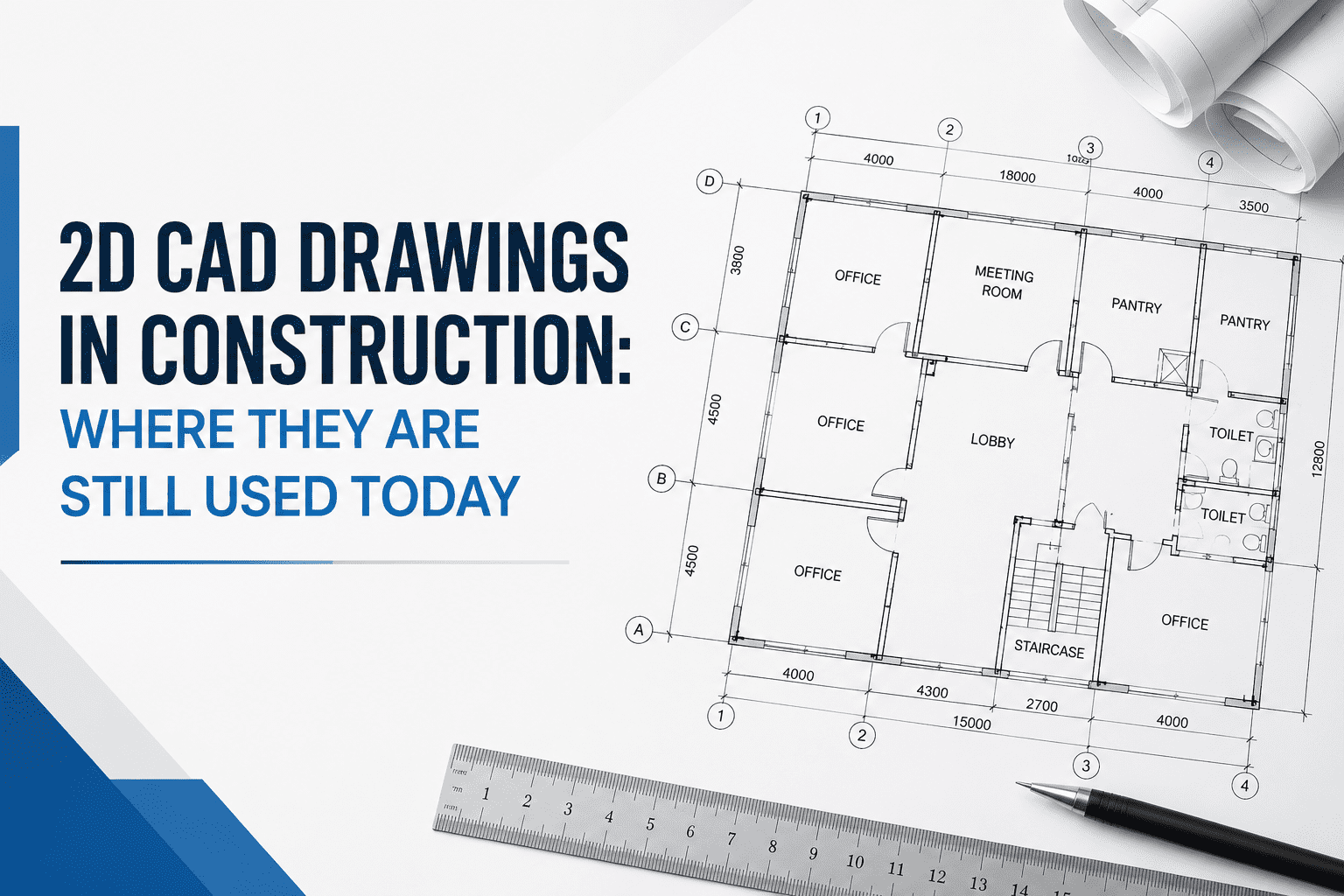
2D CAD Drawings in Construction: Where They Are Still Used Today
Even with the rapid growth of BIM, digital twins, and 3D modeling, 2D CAD drawings remain one of the most actively used technical tools in construction today. In real project execution, most contractors, consultants, fabricators, and site teams still depend on 2D drawings because they are fast to read, easy to issue, simple to revise, and practical during daily construction work.
Many people assume 3D has replaced 2D completely. That is incorrect.
In reality, 3D models are often used for coordination and visualization, but 2D CAD drawings remain the final communication format for construction execution, approvals, fabrication, and site installation. Even in BIM-led projects, teams still extract 2D sheets from models because field teams need clear dimensions, notes, levels, and technical references in a simple format.
This is why 2D CAD continues to stay relevant across architecture, structural engineering, MEP systems, and construction documentation.
Why 2D CAD Drawings Still Matter in Modern Construction
The biggest reason 2D CAD remains widely used is clarity.
Construction teams do not always need visual depth. They need exact dimensions, levels, references, and instructions that can be understood quickly.
A site engineer checking a slab opening, an electrician reviewing cable tray routing, or a fabricator reading steel dimensions usually works faster with a 2D sheet than with a full 3D model.
2D drawings also allow:
- faster revisions
- easier printing
- simpler approvals
- lightweight file sharing
- quick markup during meetings
In many projects, 2D drawings are still the fastest way to issue technical updates between consultants and contractors.
1. Architectural Floor Plans Still Depend on 2D CAD
One of the strongest areas where 2D CAD is still used today is architectural planning.
Before construction starts, architects issue floor plans in 2D because they clearly show:
- room layout
- wall thickness
- door positions
- window sizes
- circulation flow
- dimensions
Even if a project has a BIM model, floor plans are still issued as 2D sheets for approval and site reference.
Contractors rely on these drawings daily because they remain easier to print, review, and compare against site conditions.
For authority approvals, many submissions still require 2D documentation because reviewing agencies prefer standardized drawing sheets.
2. Elevations and Sections Are Still Primarily Delivered in 2D
Building elevations and sections continue to depend heavily on 2D CAD.
These drawings explain:
- vertical relationships
- floor levels
- façade dimensions
- slab heights
- roof details
A section often communicates construction intent better than a 3D view because it isolates technical depth clearly.
Even when elevations are developed from 3D models, final issue sheets remain 2D because contractors and consultants review dimensions more easily in flat format.
This remains standard across residential, commercial, and industrial projects.
3. Structural Drawings Still Rely Heavily on 2D Sheets
Structural engineering is one of the strongest examples where 2D CAD remains essential.
Structural drawings include:
- column layouts
- beam schedules
- footing details
- slab reinforcement
- rebar sections
Site teams cannot place reinforcement using only 3D models.
They need 2D bar bending references, spacing details, and section cuts.
Even advanced structural software still generates final reinforcement drawings as 2D outputs because construction teams read them faster on site.
4. MEP Layouts Are Still Widely Produced in 2D
Mechanical, electrical, and plumbing systems still use large volumes of 2D CAD drawings.
This includes:
- HVAC duct layouts
- electrical lighting plans
- cable tray routing
- plumbing drainage layouts
- fire protection drawings
Even when BIM coordination is used, final installation teams usually receive 2D sheets for execution.
Why?
Because site installation requires immediate dimensional reference.
An electrician installing conduits does not always need a full model—he needs route, level, symbol, and dimension.
That is why 2D MEP drawings remain one of the most actively used drawing types in live projects today.
5. Shop Drawings Depend Strongly on 2D CAD
Shop drawings are one of the most practical uses of 2D CAD in construction.
These drawings explain exactly how elements should be fabricated and installed.
They are used for:
- steel fabrication
- HVAC duct fabrication
- joinery details
- glass systems
- aluminum works
- pipe spool drawings
Fabricators need exact dimensions, bends, material notes, and installation references.
2D remains stronger here because too much visual information from 3D often slows fabrication reading.
This is why fabrication workshops still heavily depend on 2D CAD sheets.
6. As-Built Drawings Are Mostly Delivered in 2D
After project completion, as-built documentation is usually issued in 2D.
These drawings record actual installation conditions.
They show:
- revised routes
- final dimensions
- relocated equipment
- service changes
Facility teams use as-built drawings for maintenance and future modifications.
2D is preferred because maintenance teams need clear records rather than model navigation.
Even large facilities often archive final as-built packages mainly as DWG and PDF sheets.
7. Permit Drawings Still Require 2D Submission
Many approval authorities still request 2D permit drawings.
This includes:
- municipality approvals
- fire authority approvals
- utility submissions
- technical review packages
Authorities prefer standardized sheets because they are easier to verify.
This is especially true in regulated construction markets where submission formats are strict.
Even BIM projects usually convert approval packages into 2D before submission.
8. Site Markups and Revision Work Are Faster in 2D
During construction, changes happen constantly.
A wall shifts.
A duct reroutes.
A pipe level changes.
These updates are often marked directly on 2D sheets first because:
- revision is faster
- printing is immediate
- teams understand markups easily
This is one reason 2D remains practical even when 3D models exist.
In urgent site meetings, teams still spread printed 2D drawings across tables because decision-making becomes faster.
9. BIM Projects Still Output 2D Drawings
A common misunderstanding is that BIM removes 2D drawings.
In reality, BIM still produces large numbers of 2D sheets.
From a BIM model, teams extract:
- plans
- sections
- elevations
- details
- schedules
A recent research study confirmed that BIM workflows still require dedicated 2D drawing generation because documentation remains essential for construction communication.
So BIM does not replace 2D.
It strengthens how 2D is generated.
10. Why Contractors Still Prefer 2D for Daily Execution
Contractors often prefer 2D because it fits actual site workflow.
2D drawings are:
- easier on tablets
- easier on printed sheets
- easier to compare with measurements
- simpler during toolbox discussions
3D helps planning.
2D helps execution.
That practical difference keeps 2D relevant.
2D CAD vs 3D: Where Each Works Best
Why 2D CAD Will Continue to Stay Relevant
Even with AI, BIM automation, and cloud collaboration growing, 2D CAD is unlikely to disappear.
The reason is simple:
Construction still needs fast technical communication.
As long as buildings are physically built by teams reading sheets, 2D remains essential.
Software evolves.
But field communication still depends on direct technical drawings.
Conclusion
2D CAD drawings continue to play an essential role in modern construction because they provide the clarity, speed, and technical precision that project teams still need every day. From architectural layouts and structural detailing to shop drawings and MEP installation, 2D remains one of the most practical formats for execution, approvals, and site communication.
Even as BIM and advanced digital tools become more common, 2D drawings remain the final working reference for many contractors, fabricators, and engineers because they simplify technical decision-making during active construction. That is why many projects still depend on reliable 3D design and modeling Qatar when accuracy, fast revisions, and construction-ready documentation are critical for successful delivery.